

How to read supplement labels: a 2026 guide
TL;DR:
- Reading supplement labels carefully is essential to distinguish between quality and misleading claims. The Supplement Facts panel provides critical information on serving size, ingredient amounts, and safety certifications, yet many consumers skip over it. Accurate label interpretation involves checking serving size first, analyzing ingredient doses, and verifying third-party certification marks for genuine quality assurance.
Understanding how to read supplement labels is the essential skill that separates informed supplementation from guesswork. The Supplement Facts panel, a standardised panel found on every dietary supplement sold in the UK and EU, contains everything you need to assess a product’s actual value. Yet most people scan the front of the pack and miss the critical data on the back. This guide walks you through every section of a supplement label, from serving size to third-party certification marks, so you can make confident, evidence-based choices for yourself or those in your care.
How to read supplement labels: key components explained

The Supplement Facts panel is the most important section on any supplement label. Serving size and servings per container appear at the top of the panel and must be read first. Every ingredient amount listed below applies to one serving, not one tablet or capsule, unless those happen to be the same thing.
Here is what each component tells you:
- Serving size: The quantity you must take to receive the listed ingredient amounts. A product showing 500 mg of magnesium per serving means nothing until you know whether that serving is one capsule or four.
- Supplement Facts panel: Lists every dietary ingredient, its amount per serving, and its % Daily Value where one has been established. Vitamins and minerals typically carry a %DV; botanical extracts and amino acids often do not.
- % Daily Value (%DV): Shows how much of the recommended daily intake one serving provides. Ingredients without an established DV carry a footnote marked with an asterisk, indicating no reference value exists.
- Proprietary blends: A single combined amount is listed for the blend, but individual ingredient amounts are not disclosed. This makes it impossible to verify whether any single ingredient reaches a clinically relevant dose.
- Other ingredients and allergens: Allergen declarations and fillers, binders, and coatings appear below the main panel, listed in descending order by weight. Check this section if you have food sensitivities.
- Structure/function disclaimers: Any claim such as “supports bone health” must be accompanied by the FDA-required disclaimer stating the claim has not been evaluated by the Food and Drug Administration and the product is not intended to diagnose, treat, cure, or prevent any disease.
Pro Tip: Always check whether the serving size matches how you intend to take the product. A label showing impressive nutrient amounts may require you to take six capsules daily to achieve them.
How do you identify quality and safety markers?
Third-party certification marks are the most reliable external quality signals on a supplement label. Organisations such as NSF International and USP (United States Pharmacopeia) test products independently to verify that what is on the label is actually in the bottle, in the stated amounts, and free from harmful contaminants. The NSF certification mark confirms manufacturing controls and contaminant testing have met defined standards.
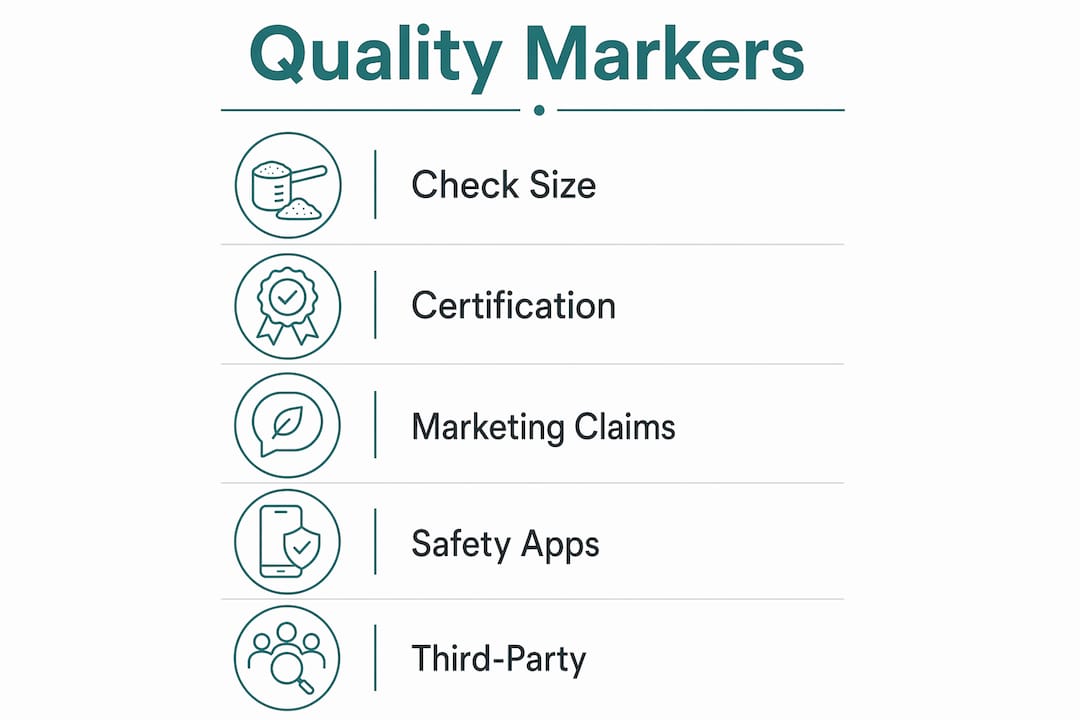
What these marks do not confirm is equally important to understand. Third-party certifications verify label accuracy and quality controls within their scope, but they do not guarantee clinical effectiveness or that a product is suitable for your personal health needs. A certified product may still contain an ingredient at a dose too low to produce any measurable effect.
Practical steps for checking certification status:
- Visit the NSF website directly and use its online product directory to confirm a mark is current and genuine.
- USP maintains a similar verified products database, searchable by product name or manufacturer.
- Treat any certification mark you cannot verify through an official directory with scepticism.
Marketing terms on the front of the pack deserve particular scrutiny. Phrases such as “clinically studied,” “maximum strength,” or “advanced formula” are promotional language. Front-label claims should always be verified against the actual ingredient doses in the Supplement Facts panel. A product labelled “maximum strength” may contain a widely studied ingredient at a fraction of the dose used in the research it references.
Pro Tip: Download the NSF Certified for Sport app or check the USP Verified database before purchasing any supplement you plan to take long-term. Verification takes under two minutes and removes significant uncertainty.
What are the most common mistakes when interpreting labels?
Serving size manipulation is the most widespread source of confusion when analysing supplement ingredients. A manufacturer can make a product appear more potent by setting the serving size at four capsules while packaging the product in a bottle that appears to contain a month’s supply. At four capsules per day, that bottle lasts two weeks.
Proprietary blends present a separate problem. The blend lists a total combined weight, but individual ingredient amounts are not disclosed. You cannot confirm whether the primary active ingredient is present at an effective dose or whether the blend is padded with cheaper components. This is a significant red flag, particularly for products making strong performance claims.
Follow this stepwise reading order to avoid errors:
- Read serving size and servings per container first. Establish what one serving actually is before reading anything else.
- Review ingredient amounts per serving. Note the unit (mg, mcg, IU) and compare against evidence-based reference doses where available.
- Check %DV presence. Identify which ingredients have established daily values and which do not.
- Examine any proprietary blends. If individual amounts are not listed, treat the blend with caution.
- Read other ingredients and allergen declarations. Identify fillers, binders, and potential allergens before purchasing.
“Practitioners read supplement labels in a strict sequence to avoid misinterpretation: serving size first, ingredient amounts, %DV, proprietary blends, then other ingredients and allergens.” — How to Read Supplement Labels (And Spot the Red Flags)
Red flags to watch for include missing disclaimers on health claims, no third-party certification on products making strong efficacy claims, and ingredient lists that group multiple compounds under a single proprietary blend name without disclosing individual amounts.
How to use supplement labels to make informed choices
Comparing two supplements side by side requires a consistent method. Use the table below as a practical framework when evaluating products:
| Label Element | What to Compare | Why It Matters |
|---|---|---|
| Serving size | Number of capsules or tablets per serving | Determines true cost per dose and daily pill burden |
| Ingredient form | E.g. magnesium glycinate vs. magnesium oxide | Bioavailability varies significantly between forms |
| Amount per serving | Milligrams or micrograms of each ingredient | Confirms whether doses align with evidence-based ranges |
| % Daily Value | Percentage relative to established reference values | Helps contextualise dose relative to daily requirements |
| Third-party mark | NSF, USP, or equivalent certification | Indicates independent quality verification |
The Linus Pauling Institute recommends targeting 50%–150% DV for most vitamins and minerals in a multivitamin, and avoiding doses above 200% DV except for a small number of nutrients with established safety at higher levels. This range provides a practical benchmark when you are comparing products and trying to avoid both under-dosing and unnecessary excess.
Consulting a healthcare provider before starting any new supplement remains the most reliable safeguard. This is particularly relevant for caregivers managing supplements for older adults, where interactions with prescribed medicines are a genuine concern. A GP or registered dietitian can cross-reference your supplement choices against your current health status and medications.
Tracking effectiveness over time is also part of informed use. The Supplement Facts panel serves as your reference point for monitoring whether a product is delivering what you expect at the dose you are taking. If you adjust the dose or switch products, the label is where you return to confirm what changed.
Pro Tip: When comparing two products with the same active ingredient, check the ingredient form, not just the amount. Magnesium glycinate and magnesium oxide both appear as “magnesium” on a label, but their absorption rates differ considerably.
Key takeaways
Reading supplement labels accurately requires a structured approach, starting with serving size and working through ingredient amounts, %DV, proprietary blends, allergens, and certification marks in a fixed sequence.
| Point | Details |
|---|---|
| Start with serving size | All ingredient amounts on the label apply to one serving, not one tablet. |
| Check %DV in context | Aim for 50%–150% DV for most nutrients; avoid exceeding 200% DV without professional guidance. |
| Scrutinise proprietary blends | Undisclosed individual amounts make it impossible to verify effective doses. |
| Verify certification marks | Use the NSF or USP online directories to confirm any certification mark is genuine and current. |
| Look beyond front-label claims | Marketing language like “maximum strength” must be verified against actual Supplement Facts panel data. |
Why label literacy is the habit most supplement users skip
I have spent years reviewing supplement labels across hundreds of products, and the single most consistent finding is this: most people never get past the front of the pack. They read a claim, recognise a familiar ingredient name, and buy. The Supplement Facts panel, which contains the only information that actually matters, goes unread.
The certification mark issue is one I feel strongly about. NSF and USP marks are genuinely useful. They tell you a product has been independently tested and that the label is accurate. But I have seen people treat a certification mark as a substitute for reading the label at all. That is a mistake. A certified product can still contain an ingredient at a dose that is too low to be meaningful for your specific goal. Certification confirms quality. It does not confirm suitability.
The proprietary blend problem is where I see the most frustration among people who are genuinely trying to make good choices. A blend listing “500 mg herbal complex” tells you almost nothing. The most expensive ingredient in that blend could be present at 10 mg while cheaper fillers make up the rest. If a product you are considering relies heavily on proprietary blends and makes strong efficacy claims, that combination warrants real scrutiny. Compare it against a product that discloses individual ingredient amounts. The supplement comparison guide on the Vivetus blog is a useful starting point for that process.
The most practical shift you can make is to treat label reading as a skill you practise, not a one-time task. The more labels you read in sequence, the faster and more reliable your judgement becomes.
— Jord
How Vivetus supports your supplement choices
Vivetus is built around the principle that supplement quality should be transparent and verifiable, not hidden behind marketing language.
The Vivetus blog provides detailed, evidence-based guides covering everything from interpreting the Supplement Facts panel to comparing ingredient forms for healthy ageing. Every product in the Vivetus catalogue is selected with label transparency in mind, so you can apply what you have learned here directly to your purchasing decisions. Visit Vivetus to explore the full range of supplements and access practical resources that support confident, informed choices at every stage of your health journey.
FAQ
What is the supplement facts panel?
The Supplement Facts panel is the standardised information box on every dietary supplement label. It lists serving size, ingredient amounts per serving, and % Daily Value where established.
How do proprietary blends affect label reading?
Proprietary blends disclose a total combined weight but not individual ingredient amounts. This makes it impossible to confirm whether any single ingredient is present at a clinically relevant dose.
What does % daily value mean on a supplement label?
% Daily Value shows how much of the recommended daily intake one serving provides. The Linus Pauling Institute recommends targeting 50%–150% DV for most vitamins and minerals in a standard multivitamin.
Are third-party certification marks a guarantee of effectiveness?
No. Marks from NSF International or USP confirm label accuracy and manufacturing quality, but they do not guarantee clinical effectiveness or personal suitability for your health goals.
What are the biggest red flags on a supplement label?
The main red flags are undisclosed proprietary blend amounts, missing disclaimers on health claims, and front-label marketing terms that cannot be verified against the Supplement Facts panel data.