

What is active aging? A practical guide for over 50s
TL;DR:
- Active aging focuses on enhancing health, participation, and security across all life stages to improve quality of life. Engaging in regular physical, mental, and social activities yields significant physical, cognitive, and emotional benefits, helping to prevent decline. Building small, consistent habits rooted in functional goals encourages lifelong well-being and societal contribution.
Active aging is defined by the World Health Organisation as the process of optimising opportunities for health, participation, and security to enhance quality of life as people grow older. This definition, built on three core pillars, covers physical, mental, social, and spiritual well-being rather than fitness alone. For adults aged 50 and over, understanding what active aging means in practical terms is the first step towards making choices that genuinely improve daily life. The evidence is clear: consistent, manageable habits started now produce measurable gains in independence, cognitive health, and emotional resilience.
What is active aging and why does it matter?
Active aging, as the WHO framework defines it, rests on three pillars: health, participation, and security. Health covers physical and mental function. Participation means staying engaged in social, economic, and civic life. Security refers to protection from harm and access to support when needed. Together, these pillars describe a whole-person approach that the International Council on Active Aging also promotes through its work with communities and care providers worldwide.
The importance of active aging extends beyond individual benefit. Active aging shifts societal views from decline and dependency towards recognising older adults as valuable contributors. This matters because how society frames ageing directly affects how individuals feel about their own prospects. When the narrative changes, motivation follows.
Active aging is also not a concept reserved for later life. Benefits accumulate across life stages, building resilience through mind, body, community, and purpose. Starting at 50 rather than 70 gives you a longer runway to build habits that compound over time.
What are the key benefits of active aging for adults over 50?
The physical benefits of active aging are well documented and specific. Regular physical activity reduces the risk of dementia, depression, heart disease, stroke, type 2 diabetes, and eight specific cancers including breast and colon cancer. That list alone makes physical activity one of the most powerful modifiable factors available to adults over 50.
Mental benefits are equally significant. Sustained cognitive engagement through learning, problem-solving, and social interaction builds what researchers call cognitive resilience. This does not mean ageing stops affecting the brain. It means the brain develops greater capacity to absorb and compensate for age-related changes, reducing the functional impact of those changes on daily life.
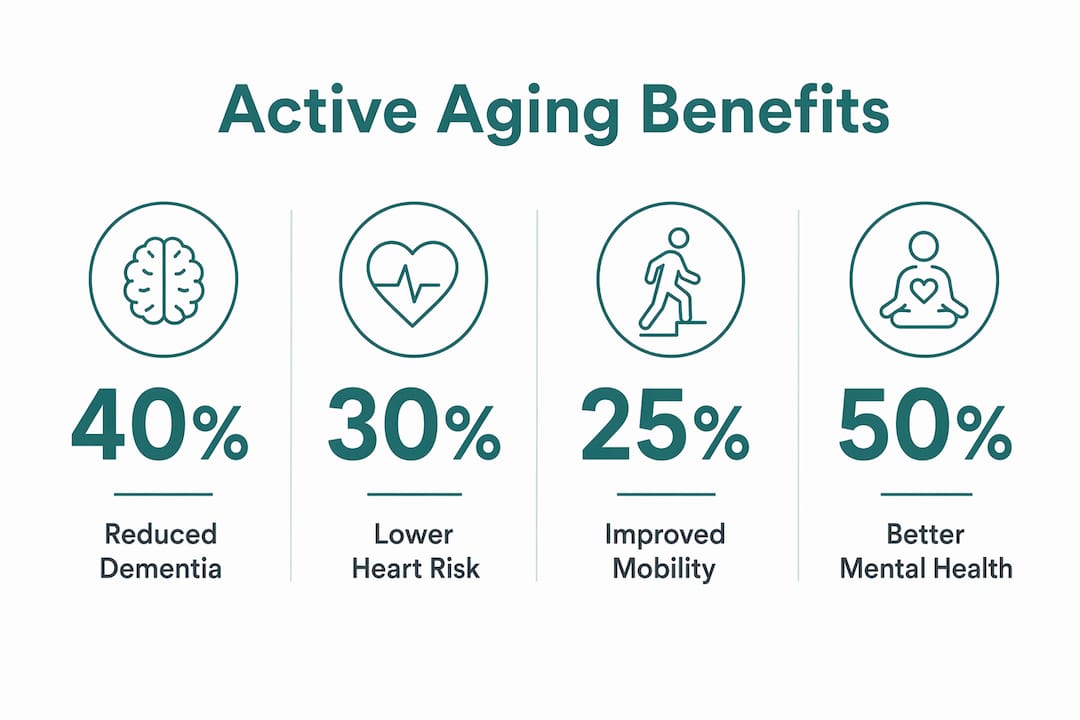
Social benefits are often underestimated. Staying connected to community, whether through volunteering, group exercise, or shared hobbies, produces measurable improvements in emotional well-being and sense of purpose. Isolation, by contrast, is associated with faster cognitive decline and poorer physical health outcomes.
Key active aging benefits at a glance:
- Reduced chronic disease risk: Lower likelihood of heart disease, stroke, and type 2 diabetes through regular movement
- Improved strength and balance: Reduced fall risk and greater independence in daily tasks
- Cognitive resilience: Slower cognitive decline and lower dementia risk through mental and physical engagement
- Emotional well-being: Better mood, lower rates of depression, and stronger sense of purpose
- Community contribution: Sustained participation in social and civic life, benefiting both individual and community
The evidence-backed gains from active aging are not marginal. They represent a meaningful difference in how you function, feel, and contribute across the decades ahead.
Which active aging strategies are most effective?
Not all approaches to active aging produce the same results, and understanding the differences helps you choose what fits your life.
| Strategy | Format | Best for | Consistency requirement |
|---|---|---|---|
| Aerobic exercise (walking, swimming) | Structured sessions | Cardiovascular health, mood | 150 min per week moderate intensity |
| Strength training | Gym or home weights | Muscle mass, bone density | 2 sessions per week |
| Balance training | Standing exercises, yoga | Fall prevention, coordination | Daily habit stacking |
| Incidental movement | Gardening, housework, walking | Overall activity volume | Throughout the day |
| Mental engagement | Learning, puzzles, reading | Cognitive resilience | Daily |
| Social participation | Clubs, volunteering, classes | Emotional health, purpose | Regular, not occasional |
Adults aged 50 and over should aim for at least 150 minutes of moderate-intensity aerobic exercise weekly, combined with muscle-strengthening activities on two days per week. That is the evidence-based benchmark from Stanford Medicine. Short sessions under 30 minutes, three times weekly, also produce significant benefits. Walking increments of just 10 minutes have been shown to reduce mortality risk.
The comparison between formal exercise and incidental movement is worth examining directly. Structured workouts produce specific, measurable gains in strength and cardiovascular fitness. Incidental movement, such as gardening, housework, and walking, combines physical effort with cognitive engagement and often social interaction. Both matter. The most effective active aging strategies use both, rather than treating them as alternatives.
Pro Tip: Consistency beats intensity every time. Three 20-minute walks per week, maintained for a year, will produce far greater long-term benefit than an intensive programme abandoned after six weeks.
How to incorporate active aging into daily life
Practical integration is where most people struggle. The gap between knowing what to do and actually doing it consistently is closed by making active aging habits small, specific, and attached to things you already do.
-
Start with a functional goal. Rather than targeting a fitness number, identify a practical outcome: carrying shopping without discomfort, climbing stairs without pausing, or maintaining balance on uneven ground. Functional outcomes are more motivating and more directly relevant to daily independence than abstract metrics.
-
Use habit stacking for balance training. Balance training started in your 50s significantly reduces fall risk later. Standing on one leg while brushing your teeth requires no equipment and takes no extra time. Improved balance also correlates with improved survival rates in older adults.
-
Add movement to existing routines. Walk after meals rather than sitting immediately. Stretch during television adverts. Take stairs when available. Short, consistent movement breaks are more effective for long-term adherence and brain health than sporadic intense workouts.
-
Schedule social activity as seriously as physical activity. Join a walking group, attend a class, or commit to regular contact with friends. Social engagement is not optional in active aging. It is a core strategy with direct health outcomes.
-
Track progress in functional terms. Note whether daily tasks feel easier, whether your balance has improved, or whether your energy levels are more consistent. These markers keep motivation grounded in real life rather than abstract targets.
Pro Tip: Starting with 10-minute walks builds confidence and consistency more effectively than attempting major lifestyle overhauls. Add five minutes per week until you reach your target.
For a detailed breakdown of daily habits that support these goals, the practical guide for 2026 from Vivetus covers evidence-based day-to-day practices in depth.
What are the common misconceptions about active aging?
Several persistent myths prevent adults from engaging with active aging principles. Addressing them directly removes unnecessary barriers.
- “Active aging means intense workouts.” It does not. The WHO definition covers participation, security, and social engagement alongside physical activity. A daily walk, a weekly class, and regular contact with friends all count.
- “It’s only relevant once you’re elderly.” Active aging applies across all adult life stages. Habits built at 50 produce compounding benefits by 70. Waiting until decline is visible means starting from a weaker baseline.
- “Ageing inevitably means decline and dependency.” Evidence contradicts this directly. Small, consistent efforts in movement, learning, and social connection yield significant benefits. Dependency is not an inevitable outcome of ageing. It is often the result of inactivity.
- “Active aging is only about physical health.” Mental stimulation, social participation, and sense of purpose are equally central. An active mind and an engaged social life produce health outcomes comparable to physical exercise.
- “You need special equipment or gym membership.” Balance exercises require no equipment. Walking requires only suitable footwear. Gardening, housework, and community activities all contribute to active aging without cost.
What role do physical, mental, and social activities play?
These three dimensions do not operate independently. They reinforce each other in ways that produce outcomes greater than any single dimension alone.
| Dimension | Primary benefit | Example activity | Secondary benefit |
|---|---|---|---|
| Physical | Strength, mobility, disease prevention | Walking, swimming, strength training | Improved mood, better sleep |
| Mental | Cognitive resilience, memory | Learning a language, reading, puzzles | Reduced anxiety, sense of achievement |
| Social | Emotional well-being, purpose | Volunteering, group classes, clubs | Physical motivation, accountability |
Gardening is a useful illustration of how these dimensions intersect. It involves physical effort (digging, lifting, carrying), cognitive engagement (planning, problem-solving, learning about plants), and often social connection through community gardens or shared knowledge. Activities with purpose engage brain-body connections in ways that single-dimension activities do not. This is why the most effective active aging strategies tend to combine all three dimensions rather than isolating one.
Research linking these domains to longevity is consistent. Physical activity reduces biological markers of ageing. Mental engagement slows cognitive decline. Social participation reduces inflammation and improves immune function. The evidence-based strategies that address all three simultaneously produce the strongest outcomes.
Key takeaways
Active aging produces its greatest benefits when physical movement, mental engagement, and social participation are combined consistently rather than pursued in isolation.
| Point | Details |
|---|---|
| Active aging is holistic | The WHO definition covers health, participation, and security, not fitness alone. |
| Consistency matters more than intensity | Short, regular activity sessions outperform sporadic intense workouts for long-term adherence. |
| Start balance training at 50 | Habit stacking simple balance exercises reduces fall risk and supports independence. |
| Functional goals sustain motivation | Targeting practical outcomes like carrying shopping beats chasing abstract fitness numbers. |
| All three dimensions connect | Physical, mental, and social activities reinforce each other and produce compounding benefits. |
Why I think the framing of active aging changes everything
From my perspective, the most significant barrier to active aging is not physical capacity. It is the story people tell themselves about what ageing means. The moment someone accepts that decline is inevitable, they stop making the small choices that prevent it. That mental shift is where active aging either takes hold or fails.
What I find genuinely useful about the WHO framework is that it removes the pressure of performance. You are not trying to be fitter than your younger self. You are trying to maintain function, connection, and purpose. Those are achievable goals at any starting point. A 10-minute walk after dinner is not a consolation prize. It is a direct intervention in your biological ageing process.
The social dimension is the one most people underinvest in. Physical activity gets attention because it is visible and measurable. But the research on social isolation and health outcomes is just as compelling. Joining a group, showing up regularly, and building relationships around shared activity produces health benefits that no supplement or exercise programme can fully replicate on its own.
My honest observation is this: the people who age well are not the ones who follow the most rigorous programme. They are the ones who find activities they genuinely want to return to, connect those activities to people they enjoy, and keep showing up. That is the whole strategy, made simple.
— Jord
Support your active aging with Vivetus
Vivetus provides scientifically backed supplements and nutritional products designed specifically to support healthy ageing and overall vitality. Whether you are looking to complement your physical activity with targeted nutrition, or seeking guidance on longevity strategies and supplements that align with active aging principles, Vivetus offers a practical starting point. The product range is built around the same evidence base that underpins the strategies covered in this article. Explore the full range at vivetus.eu and find the nutritional support that fits your goals.
FAQ
What does active aging mean in simple terms?
Active aging means making choices that maintain your health, independence, and social engagement as you grow older. The WHO defines it as optimising opportunities for health, participation, and security to enhance quality of life.
What are the main active aging benefits for people over 50?
Regular physical activity reduces the risk of dementia, heart disease, stroke, type 2 diabetes, and several cancers. Mental and social engagement add cognitive resilience and emotional well-being on top of those physical gains.
How much exercise do adults over 50 need for active aging?
Stanford Medicine recommends at least 150 minutes of moderate-intensity aerobic exercise per week, plus muscle-strengthening activities on two days per week. Short sessions of under 30 minutes, three times weekly, also produce significant benefits.
How can I promote active aging without a gym membership?
Walking, gardening, balance exercises at home, and community social activities all contribute to active aging without cost or equipment. Habit stacking, such as standing on one leg while brushing your teeth, is an effective daily balance practice.
Is active aging only relevant for older adults?
Active aging applies across all adult life stages. Habits built at 50 produce compounding benefits by 70, making early adoption significantly more effective than waiting until decline becomes visible.