

The role of B vitamins in aging: a guide for over-50s
TL;DR:
- B vitamins are critical for slowing cellular aging, supporting mitochondrial function and cognitive health, especially after age 50. Their absorption declines with age, making supplementation important; proper testing like MMA can detect hidden deficiencies better than standard blood tests. Maintaining optimal B vitamin levels through targeted supplements can delay neurodegeneration, preserve muscle mass, and promote healthy aging.
B vitamins are essential micronutrients that regulate DNA methylation, mitochondrial energy production, and neurological maintenance, making them central to how your body ages at a cellular level. For adults over 50, the stakes are higher than most realise. Absorption declines with age, deficiencies often go undetected, and the consequences range from accelerated cognitive decline to measurable changes in biological age. This article covers the science behind B vitamins and longevity, explains why older adults are disproportionately affected, and gives you practical steps to maintain optimal levels.
How do B vitamins influence cellular aging and metabolism?
The role of B vitamins in aging begins at the molecular level, where these nutrients act as cofactors in processes that determine how quickly your cells age. B12, folate (B9), and riboflavin (B2) are particularly active in DNA methylation, the mechanism that controls gene expression and protects chromosomal integrity. When methylation falters, biological aging accelerates. Higher dietary intake of B2 and B9 is directly associated with lower KDM-acceleration scores on epigenetic clocks, which are the most precise current measure of biological age. That means people eating more of these vitamins are, biologically, ageing more slowly.

Mitochondrial function is the other major pathway. B vitamins serve as cofactors in the citric acid cycle and oxidative phosphorylation, the processes your mitochondria use to generate ATP. Without adequate B12 in particular, mitochondrial dysfunction accumulates, impairing lipid metabolism and epigenetic regulation across multiple aging pathways. A 2026 Cornell mouse study identified B12 as a central regulator capable of restoring mitochondrial capacity in aged models. B vitamins also modulate oxidative stress through sirtuin signalling pathways, which govern cellular repair and longevity responses.
The table below summarises the key B vitamins and their specific roles in cellular aging.
| B vitamin | Primary cellular role | Aging relevance |
|---|---|---|
| B2 (Riboflavin) | Electron transport, antioxidant recycling | Lower biological age scores with higher intake |
| B6 (Pyridoxine) | Amino acid metabolism, neurotransmitter synthesis | Supports homocysteine clearance |
| B9 (Folate) | DNA methylation, cell division | Epigenetic clock deceleration |
| B12 (Cobalamin) | Myelin synthesis, mitochondrial regulation | Cognitive preservation, muscle health |
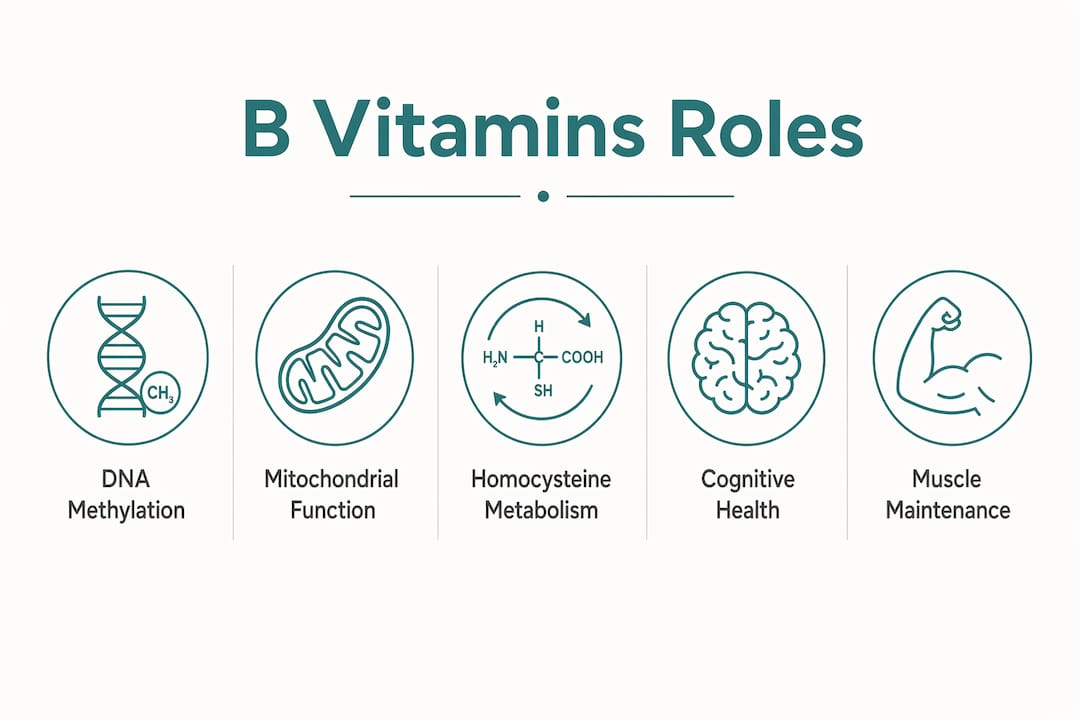
Mitochondrial dysfunction linked to B12 deficiency also contributes to sarcopenia, the age-related loss of muscle mass and strength. Supplementation may restore oxidative phosphorylation capacity, supporting muscle health alongside cognitive and metabolic function.
What evidence links B vitamin status with cognitive health in seniors?
The connection between B vitamin status and brain aging is one of the most thoroughly researched areas in nutritional gerontology. A 2026 study of over 16,000 patients found that higher B12 status correlates with slower cognitive decline, with optimal levels above 400 pg/mL preserving cognitive function by approximately half a year in older adults. Half a year may sound modest, but at the population level, it represents a meaningful delay in the onset of functional impairment.
The mechanism runs largely through homocysteine. Elevated homocysteine, driven by low B12, B6, and folate, is a recognised risk factor for dementia and brain atrophy. B vitamins are required to convert homocysteine back to methionine or cysteine. When levels of these vitamins fall, homocysteine accumulates and damages cerebrovascular tissue. The gut-immune-brain axis is also implicated here. B vitamins influence systemic and neuroinflammation through the gut microbiome, adding another route by which deficiency accelerates cognitive aging.
The interaction with sleep is particularly striking. Research examining data from over 8,800 older adults found that low B vitamin intake combined with poor sleep has a synergistic effect on cognitive impairment risk, meaning the combined impact is greater than either factor alone. This matters because sleep quality typically declines after 50, making B vitamin status an even more critical variable for this age group.
Key findings from the cognitive research:
- B12 levels above 400 pg/mL are associated with measurably slower cognitive decline in adults over 60
- Elevated homocysteine from B vitamin deficiency is linked to increased dementia risk and brain volume loss
- Poor sleep and low B vitamin intake together produce additive cognitive impairment risk
- B vitamins influence neuroinflammation via the gut microbiome, not only through direct neurological pathways
Pro Tip: Aim for B12 serum levels between 400 and 600 pg/mL rather than simply staying above the standard laboratory minimum of 200 pg/mL. Research identifies this range as optimal for cognitive preservation, and many adults over 50 sit in the 200 to 400 range without any clinical flag being raised.
Why do B vitamin deficiencies commonly occur in people over 50?
Deficiency in older adults is not primarily a dietary problem. It is an absorption problem. Gastric acid production declines with age, and B12 in particular requires adequate stomach acid and intrinsic factor for absorption from food. The Linus Pauling Institute confirms that supplements are often necessary for older adults to maintain adequate serum B12, even when dietary intake appears sufficient. This is why food sources alone frequently fail to close the gap after 50.
Common risk factors for B vitamin deficiency in adults over 50:
- Reduced gastric acid secretion, impairing B12 absorption from animal foods
- Altered gut microbiota reducing synthesis and absorption of B vitamins including B9 and B7
- Use of proton pump inhibitors or metformin, both of which deplete B12
- Low dietary variety or reduced appetite, common in older adults living alone
- Malabsorption conditions including atrophic gastritis and coeliac disease
The diagnostic gap compounds the problem. Standard serum B12 tests miss up to 45% of functional deficiencies in older adults. That is a substantial proportion of people receiving false reassurance from routine blood work. Methylmalonic acid (MMA) and holotranscobalamin (holoTC) are more accurate functional markers, as they reflect tissue-level B12 availability rather than simply what is circulating in the blood. Many functional deficiencies go undetected by routine testing, delaying treatment and allowing irreversible neurological consequences to develop.
Pro Tip: If your GP reports a normal B12 result but you are experiencing fatigue, memory lapses, or tingling in your extremities, ask specifically for an MMA test. It is a more sensitive indicator of functional B12 deficiency and is particularly relevant for adults over 60.
How can older adults effectively maintain optimal B vitamin levels?
Food remains the foundation. Animal products are the primary source of B12, with beef liver, sardines, eggs, and dairy providing the highest concentrations. Folate is abundant in dark leafy greens such as spinach and kale, as well as in legumes and fortified cereals. B6 is found in poultry, fish, potatoes, and bananas. The challenge is that bioavailability from food declines with age due to the absorption issues described above, which is why dietary intake alone is rarely sufficient for adults over 60.
The table below compares the main sources of key B vitamins for older adults.
| Source type | Examples | Bioavailability notes |
|---|---|---|
| Animal foods | Beef liver, sardines, eggs, dairy | High B12 content but absorption impaired by low gastric acid |
| Plant foods | Spinach, lentils, fortified cereals | Good folate and B6; no B12 unless fortified |
| Fortified products | Nutritional yeast, plant milks, breakfast cereals | Useful for those with low animal food intake |
| Supplements | Methylcobalamin, methylfolate, B-complex formulas | Highest bioavailability; bypasses gastric acid dependency |
For supplementation, form matters. Methylcobalamin is the active, coenzyme form of B12 and is better retained in tissue than cyanocobalamin, the cheaper synthetic form used in many standard supplements. For folate, methylfolate (5-MTHF) is preferred over folic acid for individuals with MTHFR gene variants, which affect folate metabolism and are more common than widely recognised. You can find detailed guidance on supplement choices after 50 to help you select the right forms and dosages.
One caution that applies directly to B complex and aging: folate supplementation without confirming adequate B12 can mask B12 deficiency symptoms, allowing neurological damage to progress undetected. Clinicians must check B12 status before initiating high-dose folate. If you are taking a B-complex supplement, confirm it includes a meaningful dose of B12 alongside folate.
Pro Tip: When selecting a B12 supplement, choose methylcobalamin over cyanocobalamin and look for a dose of at least 500 mcg. Sublingual tablets or sprays bypass the gastric absorption step entirely, making them particularly effective for adults with low stomach acid.
Key takeaways
B vitamins are the most evidence-supported micronutrients for slowing biological aging, and their impact on cognitive function, mitochondrial health, and epigenetic markers is greatest in adults over 50 who are already deficient.
| Point | Details |
|---|---|
| Cellular aging mechanism | B vitamins regulate DNA methylation and mitochondrial function, directly slowing biological aging. |
| Cognitive preservation | B12 levels above 400 pg/mL are linked to measurably slower cognitive decline in older adults. |
| Absorption declines with age | Gastric acid reduction after 50 impairs B12 absorption from food; supplements often become necessary. |
| Testing limitations | Standard serum B12 tests miss up to 45% of deficiencies; MMA and holoTC are more accurate markers. |
| Supplement form matters | Methylcobalamin and methylfolate offer superior bioavailability compared to synthetic alternatives. |
What I have learned from watching people overlook B vitamins for years
Most people over 50 who ask me about supplements are focused on vitamin D, omega-3s, or magnesium. B vitamins rarely come up unless someone has already been diagnosed with a deficiency. That is a significant gap, because by the time a deficiency shows up on a standard blood test, functional decline has often been underway for months or years.
The biggest misconception I encounter is that B vitamins are primarily energy boosters. They are not. Supplementation benefits are most pronounced when correcting a deficiency, not in people who are already replete. If you take a B-complex and feel no different, that does not mean the vitamins are not working. It may mean your levels were adequate to begin with, which is a good outcome.
What concerns me more is the number of people in the 200 to 400 pg/mL B12 range who are told their results are normal. That range sits below the threshold associated with cognitive preservation. The difference between a level of 250 and a level of 500 is not visible on a standard report, but the research suggests it is meaningful over a decade of aging. Early intervention, before neurological symptoms appear, is where B vitamins have the most to offer. Once peripheral neuropathy or significant cognitive decline is established, the window for reversal narrows considerably.
Personalised monitoring, including MMA testing and tracking trends in B12 over time rather than single-point snapshots, is the approach I would advocate for anyone serious about healthy aging. It is not complicated. It just requires asking the right questions.
— Jord
Support your aging health with evidence-backed B vitamin supplements

Understanding the science is the first step. Acting on it is what makes the difference. At Vivetus, you will find a curated range of B vitamin supplements for seniors formulated with bioavailable forms including methylcobalamin and methylfolate, selected specifically for adults over 50. If you are building a broader nutritional strategy, the healthy ageing supplements guide covers the full picture of what the evidence supports. Free shipping applies on orders over €50, and all products are accessible internationally through the Vivetus platform.
FAQ
What is the role of B vitamins in aging?
B vitamins regulate DNA methylation, mitochondrial energy production, and homocysteine metabolism, all of which directly influence the rate of biological aging. Adequate intake of B2, B9, and B12 is associated with lower scores on epigenetic aging clocks and slower cognitive decline.
Which B vitamin is most important for adults over 50?
B12 is the most critical for older adults because absorption declines significantly with age due to reduced gastric acid. Optimal B12 levels above 400 pg/mL are linked to preserved cognitive function and reduced dementia risk.
Can you get enough B vitamins from food alone after 50?
Food sources provide B vitamins, but absorption from animal foods declines after 50 due to reduced stomach acid. The Linus Pauling Institute states that supplements are often necessary for older adults to maintain adequate serum B12 levels.
How accurate is a standard B12 blood test?
Standard serum B12 tests miss up to 45% of functional deficiencies in older adults. Methylmalonic acid (MMA) and holotranscobalamin (holoTC) are more accurate markers of tissue-level B12 availability and are recommended for adults with absorption concerns.
Is it safe to take high-dose folate without checking B12 first?
High-dose folate supplementation without confirmed adequate B12 can mask B12 deficiency symptoms, allowing neurological damage to progress undetected. Always confirm B12 status before beginning high-dose folate or a B-complex supplement with elevated folate content.