

What is collagen supplementation: a clear guide
TL;DR:
- Collagen supplementation provides the body with raw materials necessary for collagen production but does not deliver collagen directly to tissues. Evidence suggests modest benefits for skin hydration and joint health, with product quality and dosage being critical factors. A healthy lifestyle, adequate nutrients, and realistic expectations enhance the effectiveness of collagen in supporting aging and connective tissue health.
Collagen supplementation has become one of the most talked-about topics in health and wellness, yet most people taking these products hold a fundamental misunderstanding about how they actually work. What is collagen supplementation, really? At its core, it means consuming products that provide your body with the raw materials it needs to support collagen production. It does not mean swallowing a capsule and watching collagen travel directly to your skin or joints. This guide cuts through the noise, explains the science in plain terms, and helps you decide whether collagen supplements belong in your daily routine.
Table of Contents
- Key takeaways
- What is collagen supplementation and how does it work?
- Scientific evidence for collagen supplementation effects
- Choosing and using collagen supplements wisely
- Diet, lifestyle, and supporting collagen naturally
- My perspective on collagen supplements
- Explore collagen supplements at Vivetus
- FAQ
Key takeaways
| Point | Details |
|---|---|
| Collagen is a structural protein | It supports skin, joints, and connective tissue, and natural production declines with age. |
| Supplements provide building blocks | Oral collagen is digested into peptides and amino acids, not delivered intact to tissues. |
| Evidence is promising but mixed | Skin hydration and joint function studies show benefits, though study quality varies. |
| Product quality matters greatly | Dose, formulation, and third-party testing determine whether a product is worth taking. |
| Diet and lifestyle support collagen too | Vitamin C, protein, hydration, and sun protection all contribute to collagen maintenance. |
What is collagen supplementation and how does it work?
Collagen is the most abundant protein in the human body. It forms the structural scaffolding of skin, tendons, cartilage, bones, and blood vessels. Think of it as the framework that keeps tissues firm, flexible, and intact. There are at least 28 known types of collagen, but for supplementation purposes, three matter most.
Type I is the most prevalent. It is found in skin, tendons, and bones, and is the primary target of collagen supplements marketed for skin health. Type II is concentrated in cartilage and is the focus of joint-support formulations. Type III appears alongside Type I in skin and blood vessels and is often included in products aimed at skin elasticity.
| Collagen type | Primary location | Common supplement source | Typical use |
|---|---|---|---|
| Type I | Skin, tendons, bones | Bovine, marine | Skin hydration, elasticity |
| Type II | Cartilage | Chicken sternum | Joint support, osteoarthritis |
| Type III | Skin, blood vessels | Bovine | Skin firmness, ageing support |
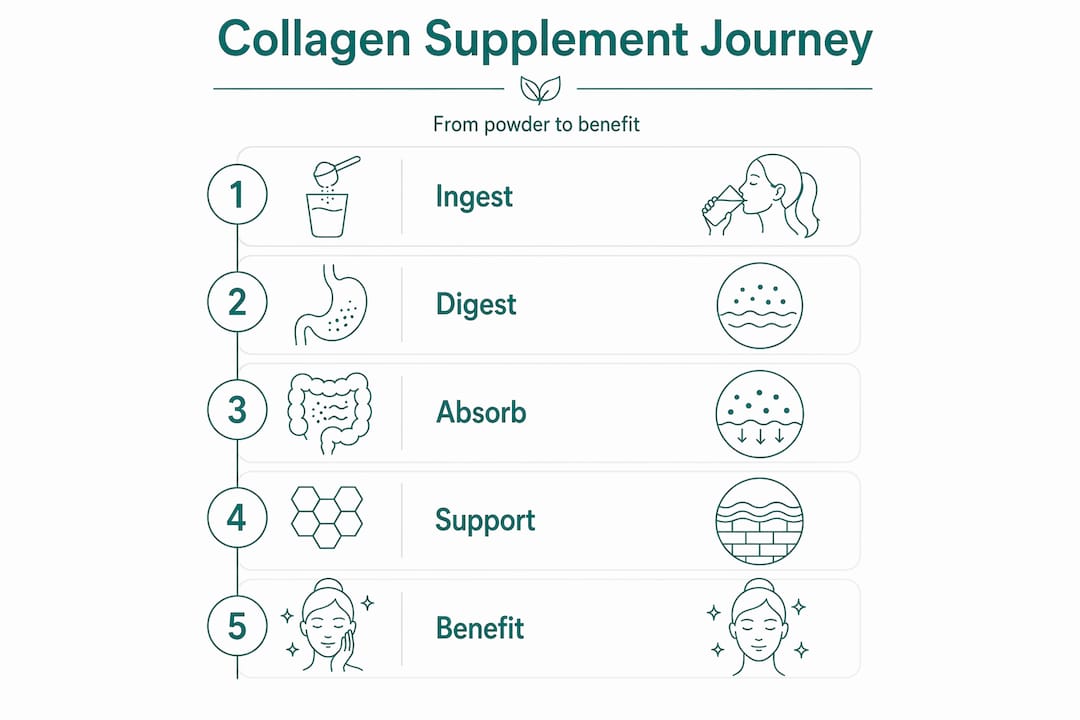
When you take a collagen supplement, your digestive system breaks it down into amino acids and smaller peptides before absorption. Supplements provide building blocks, not intact collagen delivered directly to your skin or joints. The body then uses those amino acids as it sees fit, which may include producing new collagen, but there is no guarantee they go straight to a specific tissue.
Collagen powders explained simply: most quality products use hydrolysed collagen peptides, meaning the protein has already been broken into smaller chains to improve absorption. Common sources include bovine (cattle), porcine (pig), and marine (fish) collagen. Typical research doses range from 5 to 10 grams per day for skin and connective tissue outcomes. Gummies and tablets often contain far less than this threshold, which is worth noting before you buy.
Pro Tip: When comparing collagen powders, check the label for “hydrolysed collagen peptides” specifically. Products that simply list “collagen” without specifying hydrolysed form may offer lower bioavailability.
Scientific evidence for collagen supplementation effects
The research on collagen supplementation effects is genuinely encouraging in some areas, but it requires careful reading. Not all studies are equal, and industry funding has influenced some published outcomes.
Skin health findings
A meta-analysis of 23 randomised controlled trials involving 1,474 participants found that collagen supplements improved skin hydration, elasticity, and wrinkle depth overall. However, when researchers applied sensitivity analyses to exclude lower-quality or industry-funded studies, the significant benefits largely disappeared. This does not mean collagen supplements do nothing for skin. It means the cleanest evidence is thinner than the marketing suggests.

Dermatologists generally treat oral collagen as an adjunct rather than a primary skin treatment. A collagen supplement for skin may offer modest support alongside established skincare practices such as sun protection and topical retinoids, but it is unlikely to replace them.
Joint health findings
The joint health picture is more encouraging. A 2025 randomised controlled trial assigned 160 adults with osteoarthritis to either 10 grams per day of hydrolysed collagen peptides or a placebo for eight weeks. The collagen group showed significant improvements in WOMAC scores, which measure pain, stiffness, and physical function in osteoarthritis patients. This is one of the more rigorous trials to date.
Broader systematic reviews note that evidence for joint function benefits is limited in quantity but directionally positive. More high-quality, independent trials are needed before firm conclusions can be drawn.
What the evidence tells us overall
- Skin hydration and elasticity: modest positive evidence, quality concerns noted
- Wrinkle reduction: some benefit in lower-quality trials, less clear in rigorous studies
- Osteoarthritis symptoms: promising short-term results from recent controlled trials
- Gut and bone health: early-stage research, insufficient evidence for firm claims
- Safety: generally well-tolerated at doses used in research
For context on how scientific evidence is evaluated for supplements, Vivetus has published a useful overview of clinical research in supplements that explains what to look for when assessing product claims.
Choosing and using collagen supplements wisely
The direct-delivery myth
The most persistent misconception about collagen supplements is that the collagen you swallow travels directly to your skin or joints. It does not. Ingested collagen is digested into amino acids and peptides that the body redistributes according to its own priorities. This is not a reason to dismiss supplementation entirely. It is a reason to set realistic expectations about what you are actually doing when you take a collagen product.
Format and dose differences
Not all collagen supplements are equivalent. The benefits observed in clinical trials are tied to specific hydrolysed peptide formulations at specific doses, not to collagen products in general. Gummies, for example, frequently contain 1 to 2 grams of collagen per serving, well below the 5 to 10 gram threshold used in most research. Tablets face similar constraints due to capsule size limits. Powders are generally the most practical format for reaching clinically relevant doses.
Quality and contamination risks
Marine collagen contamination with methylmercury is a documented concern when products are poorly sourced. Supplement variability across brands is significant, and many products lack independent verification of their contents. This makes third-party testing a non-negotiable consideration when selecting a product.
Here is a practical checklist for choosing a quality collagen supplement:
- Look for “hydrolysed collagen peptides” on the label, not just “collagen protein”
- Check the dose per serving. Aim for at least 5 grams for skin goals and 10 grams for joint support
- Confirm the collagen source (bovine, marine, or chicken) matches your health goal
- Choose products with third-party testing certification from recognised laboratories
- Avoid products with unnecessary fillers, artificial sweeteners, or undisclosed additives
- Read the supplement label carefully to understand what you are actually getting per serving
Pro Tip: Consistency matters more than timing. Daily dosing over time produces better outcomes than sporadic high doses. There is no definitive evidence that morning or evening intake makes a meaningful difference.
Diet, lifestyle, and supporting collagen naturally
Supplementation does not exist in isolation. Your body needs specific nutrients to synthesise collagen in the first place, and no supplement compensates for a diet that is chronically deficient in those nutrients.
Vitamin C is the most critical cofactor in collagen synthesis. Without adequate vitamin C, the body cannot properly form or stabilise collagen fibres. Zinc and copper also play supporting roles in the enzymatic processes that build collagen structure. Protein intake matters too. Collagen is a protein, and a diet low in overall protein limits the raw material available for tissue repair and maintenance.
Foods that actively support collagen production include:
- Citrus fruits, bell peppers, and strawberries (vitamin C)
- Eggs, meat, fish, and legumes (amino acids, particularly glycine and proline)
- Pumpkin seeds and cashews (zinc)
- Shellfish, nuts, and seeds (copper)
- Bone broth (naturally occurring collagen peptides and glycine)
Beyond diet, physical activity stimulates collagen synthesis in tendons and cartilage. Hydration keeps connective tissue pliable. Sun protection is arguably the single most evidence-backed intervention for preserving skin collagen. UV exposure degrades collagen faster than almost any other environmental factor, and no supplement reverses that damage once it occurs.
Is collagen good for ageing? The honest answer is that a combination of targeted supplementation, a nutrient-rich diet, and consistent lifestyle habits is far more effective than any single product. Supplements work best as additions to a solid foundation, not replacements for one. For a broader view of how collagen fits into healthy ageing, the Vivetus guide on supplements for active ageing covers the evidence in more depth.
My perspective on collagen supplements
I have followed the collagen supplement space closely for years, and my honest assessment is this: the gap between the marketing and the science is real, but it is not as wide as sceptics claim or as narrow as manufacturers suggest.
What I have observed is that people who approach collagen supplementation with realistic expectations and good product choices tend to report genuine benefits, particularly around skin hydration and joint comfort after consistent use over several months. People who expect dramatic transformations within weeks are almost always disappointed.
The studies I find most credible are those using specific hydrolysed peptide formulations at doses of 5 grams or more, with outcome measures that go beyond self-reported satisfaction. The 2025 osteoarthritis trial using WOMAC scores is a good example of the kind of rigorous methodology that should be the standard.
My caution is directed primarily at product selection. The supplement market is uneven. A product with a premium price and attractive packaging tells you nothing about the dose, purity, or formulation quality inside. Third-party testing is the single most useful filter when comparing options.
If you are considering collagen supplementation, speak with your GP or a registered dietitian first, particularly if you have existing health conditions or take medications. Supplements are not a substitute for professional guidance, and individual responses vary considerably.
— Jord
Explore collagen supplements at Vivetus
If you have done your research and are ready to choose a quality collagen product, Vivetus offers a curated range of nutritional supplements designed with healthy ageing in mind.
Vivetus prioritises ingredient transparency and product quality across its supplement range. Whether you are exploring collagen for skin support, joint health, or general wellness, the platform provides products with clear labelling and sourcing information. Free shipping is available on orders over €50, making it straightforward to get started. Browse the full range and find the right option for your goals at Vivetus.
FAQ
What is collagen supplementation exactly?
Collagen supplementation means taking oral products, typically powders, capsules, or liquids, that contain hydrolysed collagen peptides. These provide amino acids your body can use to support its own collagen production.
Do collagen supplements work for skin?
Research shows modest improvements in skin hydration and elasticity, but high-quality independent studies show less consistent results. A collagen supplement for skin works best as part of a broader skincare and nutrition routine.
How much collagen should you take daily?
Most clinical trials use between 5 and 10 grams of hydrolysed collagen peptides per day. Many gummy and tablet formats contain significantly less than this, so checking the dose per serving is important.
Are collagen supplements safe?
Collagen supplements are generally well-tolerated at research doses. The main safety concern is contamination, particularly in marine collagen products from poorly verified sources. Choosing third-party tested products reduces this risk.
Is collagen good for ageing joints?
A 2025 randomised controlled trial found that 10 grams per day of hydrolysed collagen peptides significantly improved osteoarthritis symptoms over eight weeks. Evidence is promising, though more independent trials are needed to confirm long-term benefits.