

Why use multivitamins: a practical evidence guide
TL;DR:
- Multivitamins are most beneficial for specific groups like older adults, pregnant women, and those with dietary restrictions. For healthy, well-nourished adults, evidence shows minimal disease prevention benefits, emphasizing personalized assessment over generic use. Choosing quality supplements and consulting health professionals ensures safe, targeted support rather than unnecessary or potentially harmful intake.
Many health-conscious adults reach for a daily multivitamin with the assumption that it covers all nutritional bases. The reality is more nuanced. Understanding why use multivitamins at all requires looking past marketing claims and into what the research actually shows. Some people gain clear benefits. Others see little measurable change. And a small number may face unintended risks. This guide cuts through the confusion, presenting current evidence on the benefits of multivitamins, who genuinely needs them, and how to use them wisely.
Table of Contents
- Key takeaways
- What multivitamins are and why use them
- What the science says about multivitamin benefits
- Who benefits most from multivitamins
- How to choose and use multivitamins wisely
- Common misconceptions about multivitamins
- My perspective on multivitamin use
- Support your nutrition with Vivetus
- FAQ
Key takeaways
| Point | Details |
|---|---|
| Not universal, but useful | Multivitamins benefit specific groups most, including older adults, pregnant women, and those with restricted diets. |
| Cognitive gains in older adults | The COSMOS-Mind trial found approximately 3 years less cognitive ageing with daily multivitamin use in adults over 60. |
| Absorption limits are real | Minerals compete for absorption, and fat-soluble vitamins can accumulate to harmful levels with excess intake. |
| Personalisation matters | Blood testing and life-stage-specific formulas outperform generic one-size-fits-all multivitamin products. |
| Food first, supplements second | Multivitamins cannot replicate the fibre, antioxidants, and synergistic compounds found in whole foods. |
What multivitamins are and why use them
A multivitamin is a single product combining multiple vitamins and minerals, typically at or near daily recommended intake levels. The idea is straightforward: one tablet or capsule fills in the nutritional gaps that your diet may leave behind on any given day. Think of it as nutritional insurance rather than a nutritional overhaul.
The distinction matters. Multivitamins are not designed to replace meals or whole food groups. They are a secondary tool. Whole foods provide fibre, antioxidants, and hundreds of bioactive compounds that no supplement can fully replicate. A multivitamin does not deliver the same benefit as eating a varied diet of vegetables, legumes, lean proteins, and wholegrains.
How your body absorbs nutrients from a supplement also differs from food. Several key factors affect uptake:
- Mineral competition: Calcium and iron compete for the same absorption pathways. Taking high doses of both together reduces how much of either you actually absorb.
- Fat-soluble vitamins: Vitamins A, D, E, and K dissolve in fat and accumulate in body tissue. Unlike water-soluble vitamins, excess amounts are not simply excreted.
- Absorption caps: Calcium absorption caps at roughly 500 mg per dose, meaning a tablet claiming 1,000 mg delivers less than the label implies.
- Bioavailability differences: Nutrients in food are often better absorbed due to the presence of co-factors. Folate from spinach, for example, behaves differently in the body than synthetic folic acid.
Pro Tip: Take your multivitamin with a meal containing healthy fats. This improves absorption of fat-soluble vitamins and reduces the chance of nausea from iron or zinc on an empty stomach.
What the science says about multivitamin benefits
The evidence on multivitamins is neither uniformly positive nor entirely dismissive. It depends heavily on who is being studied and what outcome is being measured.
For generally healthy, well-nourished adults, the picture is sobering. Routine multivitamin use does not significantly reduce the risk of cardiovascular disease, cancer, or premature death, based on analysis of over 390,000 participants. Major clinical review bodies have consistently reached the same conclusion: supplementing in the absence of a documented deficiency produces little measurable benefit for disease prevention.
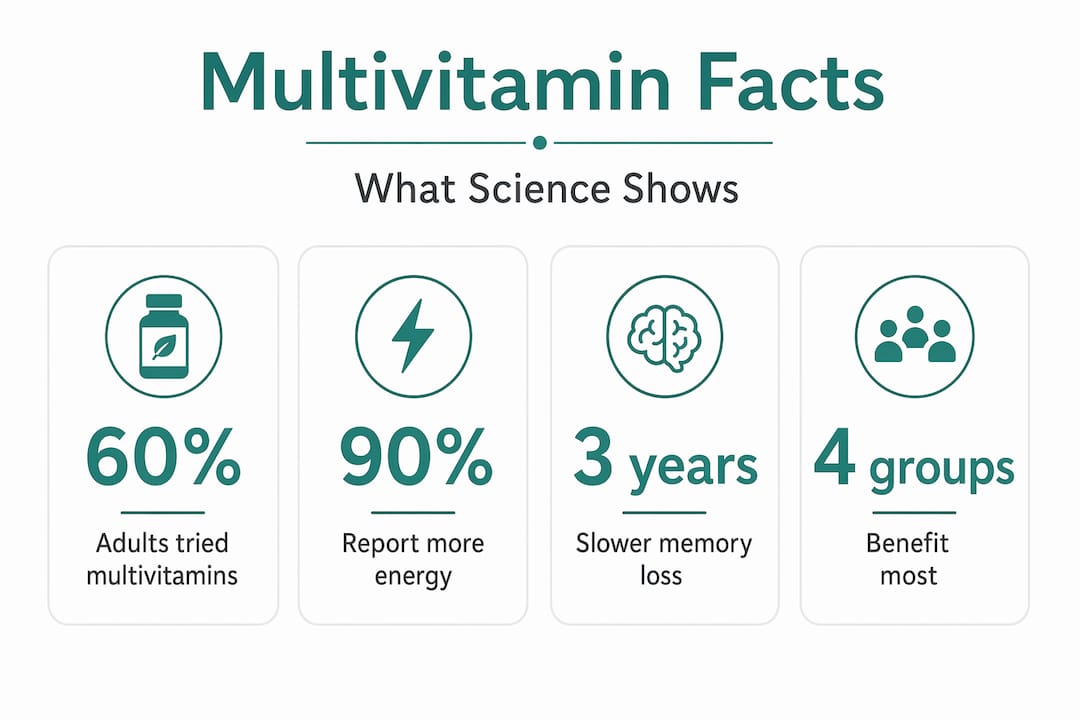
That said, the story changes for older adults. The COSMOS-Mind trial, which followed over 2,200 adults aged 60 and above, found that daily multivitamin use was associated with approximately 3 years less cognitive ageing and around 4 months of slowed biological ageing over a two-year period. These are modest but meaningful findings for a population where cognitive decline is a genuine concern.

| Population | Evidence of benefit | Key caveat |
|---|---|---|
| Healthy well-nourished adults | Minimal for disease prevention | No mortality or cardiovascular benefit found |
| Adults aged 60+ | Modest cognitive and biological ageing benefit | COSMOS-Mind trial; effect size is small |
| Pregnant women | Clear benefit for folate, iron, iodine | Targeted prenatal formulas preferred |
| Vegans and strict vegetarians | Benefit for B12, iron, zinc, omega-3 | Blanket multivitamin may not fully address gaps |
| Post-bariatric surgery patients | Significant benefit for multiple nutrients | Requires medical supervision and specific formulas |
There is also a subtler risk worth naming. Supplement users often have generally healthier lifestyles than non-users, which complicates how we interpret research outcomes. The observed benefits in some studies may partly reflect the habits of the people taking them, not the supplements themselves.
“The perception that vitamins are natural and therefore harmless is one of the most persistent misconceptions in health self-management.” — PMC clinical review
Who benefits most from multivitamins
The importance of multivitamins is not equal across all adults. Certain groups have documented nutritional needs that diet alone may not meet reliably.
Multivitamin use is most justified in the following situations:
- Pregnancy and breastfeeding: Folate is critical in early pregnancy for neural tube development. Iron, iodine, and vitamin D needs also increase significantly.
- Adults over 60: Absorption of B12, vitamin D, and calcium declines with age. The best vitamins for ageing adults differ meaningfully from what younger adults need.
- Vegans and vegetarians: B12 is found almost exclusively in animal products. Zinc, iron, and long-chain omega-3 fatty acids are also commonly low in plant-based diets.
- Post-bariatric surgery: Surgical changes to the digestive tract reduce absorption of iron, B12, calcium, and fat-soluble vitamins. Supplementation here is not optional.
- Chronic alcohol use: Alcohol interferes with the absorption and metabolism of B vitamins, particularly thiamine and folate.
- Certain chronic conditions: Conditions affecting the gut, such as Crohn’s disease or coeliac disease, can impair nutrient absorption across the board.
The key principle is that personalised supplementation based on blood testing and life stage consistently outperforms a generic approach. Knowing your actual deficiencies allows you to address them precisely rather than taking a broad-spectrum product that may deliver too much of some nutrients and too little of others.
Pro Tip: Before purchasing any multivitamin, ask your GP for a blood panel covering vitamin D, B12, ferritin, and folate. The results tell you exactly where your diet is falling short, and that shapes which product or combination is actually worth buying.
How to choose and use multivitamins wisely
Choosing a quality multivitamin is not simply a matter of picking the most popular product on the shelf. The supplement market is largely self-regulated, and quality varies considerably between brands. Here is a practical framework for making a sound choice.
-
Look for third-party testing. Certifications from organisations such as NSF International, USP, or ConsumerLab indicate that a product has been independently verified for purity, potency, and label accuracy. This matters because a product can legally contain less of a nutrient than it claims.
-
Aim for 100% of daily recommended values, not multiples. Mega-dose formulations are not more effective and carry real risks, particularly for fat-soluble vitamins. A product providing 300% of your daily vitamin A intake is not three times better. It may actually be harmful over time.
-
Understand timing and food pairing. Fat-soluble vitamins absorb better with a meal containing dietary fat. Iron absorbs better on an empty stomach but causes nausea in many people, so a light meal is a reasonable compromise. Avoid taking calcium and iron supplements simultaneously due to mineral competition.
-
Match the formula to your life stage. A multivitamin formulated for adults over 50 typically contains less iron (as post-menopausal women and older men need less) and more B12 and vitamin D. Using a generic adult formula may mean getting the wrong balance for your age.
-
Consult your GP or a registered dietitian before starting. This is especially relevant if you take prescription medications. Vitamin K interacts with blood thinners. High-dose vitamin E can affect certain cardiac medications. Your healthcare provider can flag these interactions before they become a problem.
-
Treat supplements as support, not substitutes. No multivitamin compensates for a diet built around processed foods, poor sleep, or physical inactivity. The nutritional supplements guide from Vivetus covers how to layer supplementation onto an already solid foundation of healthy habits.
Common misconceptions about multivitamins
Several persistent myths lead people to misuse or over-rely on multivitamins. Addressing them directly is useful.
The most common is the belief that “natural” means “safe.” Vitamins are not harmless simply because they are sold without prescription. Vitamin A excess causes liver injury. Vitamin K interferes with anticoagulant medications. Low-level supplementation can mask underlying deficiencies that would otherwise prompt medical investigation.
A second misconception is that more is better. Fat-soluble vitamin overdose is a real clinical concern. Unlike vitamin C, which your body excretes when intake exceeds need, vitamins A, D, E, and K accumulate in tissue. Chronic over-supplementation builds to toxic levels over months or years.
There is also the issue of behavioural displacement. Taking a multivitamin can create a false sense of security that leads some people to pay less attention to diet, exercise, and sleep. The supplement becomes a psychological substitute rather than a practical support.
“Multivitamins should be evaluated as medical interventions, not wellness accessories. That shift in framing changes how we approach their use entirely.” — PMC clinical review
Finally, over 90% of daily users report subjective improvements in energy, sleep, and mental alertness. These self-reported benefits are real experiences, but they are not consistently confirmed by clinical trials measuring hard health outcomes. The gap between how people feel and what the data shows is worth holding in mind.
My perspective on multivitamin use
I have followed the multivitamin research closely for years, and what strikes me most is how the conversation keeps getting framed as a binary. Either multivitamins work or they do not. That framing misses the point entirely.
What I have come to believe is that multivitamins are genuinely useful for a specific subset of people and largely redundant for everyone else. The uncomfortable truth is that most healthy adults eating a reasonably varied diet are not meaningfully deficient in most micronutrients. A daily multivitamin in that context is largely expensive reassurance.
Where I have seen real value is in older adults, people with dietary restrictions, and those recovering from illness or surgery. For those groups, the evidence is clear and the need is documented. The COSMOS-Mind findings on cognitive ageing are particularly compelling to me because cognitive decline is one of the areas where even modest protection has significant quality-of-life implications.
My practical take: get tested, know your numbers, and then supplement with purpose. Blanket multivitamin use without that foundation is guesswork. And guesswork, however well-intentioned, is not a health strategy.
— Jord
Support your nutrition with Vivetus
If the evidence has you thinking more carefully about your own nutritional gaps, the next step is finding a product that actually matches your needs.
Vivetus offers the Energy & Vitality Bundle, a formulation designed around the nutrient combinations most relevant to adults focused on healthy ageing and sustained vitality. The bundle draws on evidence-backed nutrient combinations rather than generic one-size-fits-all dosing. For adults over 50 or those managing specific health goals, it represents a more targeted starting point than a standard supermarket multivitamin. Explore the full range at Vivetus and consider pairing any supplement choice with a conversation with your healthcare provider for the best results.
FAQ
Are multivitamins necessary for healthy adults?
For most well-nourished healthy adults, multivitamins do not significantly reduce disease risk or mortality. They are most necessary for those with documented deficiencies, restrictive diets, or increased nutritional demands such as pregnancy.
What are the main benefits of multivitamins for older adults?
The COSMOS-Mind trial found that daily multivitamin use in adults over 60 was associated with approximately 3 years less cognitive ageing. Older adults also commonly have lower absorption of B12, vitamin D, and calcium, making supplementation more clinically relevant.
Should I take multivitamins if I eat a balanced diet?
If your diet is genuinely varied and your blood tests show no deficiencies, a multivitamin offers limited additional benefit. A blood panel is the most reliable way to determine whether supplementation is warranted for you specifically.
Can multivitamins cause harm?
Yes, in certain circumstances. Fat-soluble vitamins accumulate in the body and can reach toxic levels with prolonged high-dose use. Some nutrients also interact with prescription medications, so medical guidance is advisable before starting any supplement.
How do I choose the right multivitamin?
Look for products with third-party testing certification, aim for formulas providing close to 100% of daily recommended values rather than mega-doses, and choose a product matched to your age and health status. Consulting a registered dietitian or GP gives you the most personalised guidance.