

Why aging affects metabolism: what you need to know
TL;DR:
- Metabolism remains stable until after age 60, with muscle loss and hormonal changes driving its decline. Resistance training and daily movement help preserve muscle mass and energy regulation in older adults. Maintaining activity and proper nutrition can support metabolic resilience and healthy aging beyond 50.
Metabolism is defined as the sum of all chemical processes your body uses to convert food into energy. Resting metabolic rates remain stable from your mid-20s through your late 50s, with measurable decline starting only after age 60. The perceived midlife “crash” is not a sudden biological event. It is the cumulative result of muscle loss, hormonal shifts, and reduced daily movement building up over decades. Understanding why aging affects metabolism gives you the clearest possible basis for acting on it.
Why aging affects metabolism: the core biology
The clinical term for the body’s energy-burning capacity is basal metabolic rate, or BMR. BMR accounts for the energy your body uses at rest, covering breathing, circulation, and cell repair. As you age, several interconnected processes reduce this rate and your overall metabolic efficiency.
Muscle loss, known as sarcopenia, is the primary driver. Lean muscle tissue burns significantly more calories at rest than fat tissue does. When muscle mass falls, BMR falls with it. Hormonal changes compound this effect. Declining oestrogen, testosterone, and growth hormone alter how your body stores fat and uses energy. Cellular processes, including mitochondrial dysfunction and a process called inflammaging, further reduce the efficiency of energy production at the cellular level.

The result is not simply a slower metabolism. It is a less resilient one. Recovery from illness, stress, or periods of inactivity takes longer. Energy regulation becomes less precise. These changes are real, but they are not fixed.
How does muscle loss drive metabolic slowdown?
Sarcopenia is the age-related loss of skeletal muscle mass and strength. It begins gradually in your 30s and accelerates after 60. Because muscle is the body’s primary metabolic engine at rest, losing it directly reduces how many calories you burn each day.
Women experience a sharper shift around menopause. Declining oestrogen accelerates fat redistribution from the hips and thighs toward the abdomen, while also reducing the proportion of lean muscle. These changes in body composition in ways that further suppress BMR. Men lose muscle more gradually, but the cumulative effect over decades is relatively stable.
The practical consequence is straightforward. Less muscle means fewer calories burned at rest, which means weight gain becomes easier and energy levels drop, even when food intake stays the same.
Resistance training mitigates muscle loss more effectively than dietary changes alone. Lifting weights, using resistance bands, or doing bodyweight exercises two to three times per week preserves lean mass and keeps BMR higher. This is not optional maintenance. It is the single most effective tool adults over 50 have for protecting their metabolic rate.
Key habits that protect muscle mass as you age:
- Perform resistance training at least twice per week, targeting all major muscle groups.
- Consume adequate protein at each meal to support muscle repair and synthesis.
- Avoid prolonged periods of bed rest or inactivity, even during illness.
- Combine strength work with aerobic activity for the broadest metabolic benefit.
- Track your activity levels to identify and address gradual declines before they compound.
Pro Tip: If you are new to resistance training, bodyweight exercises such as squats, press-ups, and step-ups are a safe and effective starting point. Consistency over months matters far more than intensity in any single session.
What hormonal and cellular changes affect metabolism during aging?
Hormonal decline does more than change where fat is stored. It alters how efficiently your cells produce and use energy. Growth hormone, which supports muscle maintenance and fat metabolism, falls steadily from your 30s onward. Lower levels mean the body is slower to repair tissue and less efficient at burning stored fat for fuel.
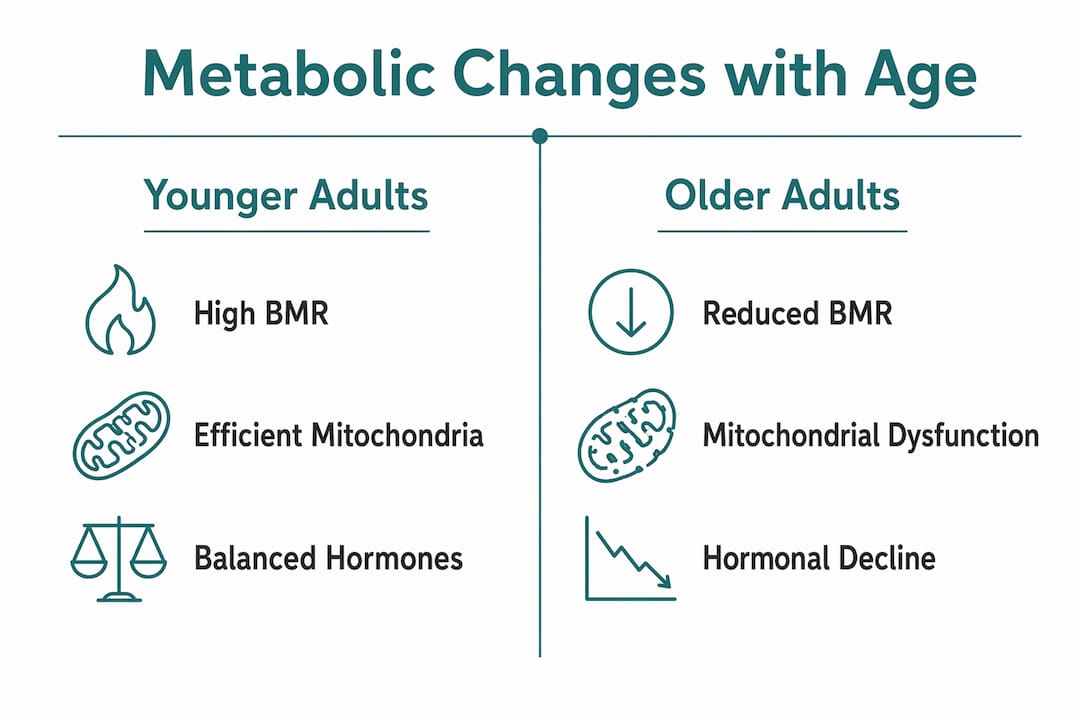
At the cellular level, two processes are particularly significant. The first is mitochondrial dysfunction. Mitochondria are the structures inside cells that convert nutrients into usable energy. With age, mitochondria become fewer and less efficient. Mitochondrial dysfunction reduces metabolic flexibility, which is the body’s ability to switch between burning carbohydrates and fats depending on what is available.
The second is inflammaging, a state of low-grade chronic inflammation that develops with age. Inflammaging and NAD+ decline impair cellular energy production, causing persistent fatigue even when caloric intake has not changed. NAD+ is a molecule central to energy metabolism inside every cell. Its levels fall significantly with age, reducing the efficiency of mitochondrial energy production.
| Metabolic process | Younger adults | Older adults |
|---|---|---|
| Mitochondrial efficiency | High | Reduced |
| NAD+ levels | Adequate | Significantly lower |
| Metabolic flexibility | Strong | Diminished |
| Hormonal support (oestrogen, growth hormone) | Stable | Declining |
| Inflammatory baseline | Low | Elevated (inflammaging) |
The table above shows that age-related metabolic decline is not a single change. It is several processes occurring simultaneously, each reinforcing the others.
How does activity level affect energy expenditure after 50?
Total daily energy expenditure, or TDEE, has three components. The first is BMR, which accounts for the largest share. The second is the thermic effect of food, the energy used to digest and process meals. The third is activity-related energy expenditure, which includes both formal exercise and all incidental movement throughout the day.
The incidental movement component has a specific name: non-exercise activity thermogenesis, or NEAT. NEAT covers everything from walking to the kitchen to fidgeting at your desk. NEAT drops significantly with age, and this reduction strongly influences total energy expenditure and is linked to increased mortality risk. The implication is clear. Formal exercise alone does not compensate for a generally sedentary day.
Reductions in fat-free mass, mitochondrial dysfunction, and decreased activity-related expenditure together drive the decline in TDEE that adults over 50 experience. Each factor amplifies the others.
| TDEE component | Adults in their 30s | Adults over 60 |
|---|---|---|
| Basal metabolic rate | Higher (more muscle) | Lower (less muscle) |
| Thermic effect of food | Relatively stable | Relatively stable |
| Exercise activity | Variable | Often reduced |
| NEAT | Higher | Significantly lower |
Practical ways to increase daily movement beyond scheduled exercise:
- Walk or cycle for short errands rather than driving.
- Take the stairs consistently rather than lifts.
- Stand or move during phone calls.
- Set a reminder to stand and move for five minutes every hour.
- Aim for a daily step count target as a simple, trackable proxy for NEAT.
Pro Tip: A basic pedometer or a phone step-counting app gives you an honest picture of your daily movement. Most adults are surprised by how low their step count is on days without formal exercise. Aim to close that gap first before adding structured workouts.
What strategies maintain metabolic health and energy after 50?
The most effective approach combines aerobic exercise, resistance training, and dietary support. Adults aged 65 and over are advised to complete 150 minutes of moderate aerobic activity per week alongside muscle-strengthening activity on at least two days. This combination addresses both cardiovascular health and the muscle preservation that keeps BMR stable.
Diet plays a supporting role that is often underestimated. Protein is the macronutrient most directly linked to muscle repair and synthesis. A balanced diet for older adults that prioritises protein at each meal, alongside adequate vegetables, healthy fats, and complex carbohydrates, gives the body the raw materials it needs to maintain lean mass and regulate energy effectively.
Metabolic flexibility deserves specific attention. Metabolic flexibility is the capacity to switch between burning carbohydrates and fats as fuel sources, and it diminishes with age. Strength training is the most evidence-backed method for preserving this capacity. Periods of moderate fasting, such as extending the overnight fast to 12–14 hours, may also support the body’s ability to shift between fuel sources, though individual responses vary.
NAD+ supplementation has attracted growing scientific interest as a way to address cellular energy decline. NAD+ supplementation targets the molecular mechanisms that reduce mitochondrial efficiency with age. Research is ongoing, and adults considering supplementation should review the current evidence carefully.
Key strategies for metabolic health after 50:
- Prioritise resistance training twice per week as a non-negotiable baseline.
- Meet the recommended 150 minutes of moderate aerobic activity weekly.
- Eat sufficient protein at every meal to support muscle maintenance.
- Keep daily movement high through NEAT, not just formal exercise.
- Consider evidence-based supplements, such as NAD+ precursors, with an informed view of the science.
Key takeaways
Age-related metabolic decline is driven by sarcopenia, hormonal shifts, and mitochondrial dysfunction, all of which are significantly modifiable through consistent resistance training and daily movement.
| Point | Details |
|---|---|
| Decline starts after 60 | Metabolic rate is stable until the late 50s; measurable decline begins after age 60. |
| Muscle loss is the primary driver | Sarcopenia reduces BMR directly; resistance training is the most effective counter-measure. |
| NEAT matters as much as exercise | Incidental daily movement declines sharply with age and strongly influences total energy expenditure. |
| Hormonal and cellular changes compound the effect | Inflammaging, NAD+ depletion, and mitochondrial decline reduce energy efficiency at the cellular level. |
| Decline is not inevitable | Remaining active, eating well, and addressing cellular health can preserve metabolic resilience into later life. |
What I have learned about metabolism and midlife
The most persistent myth I encounter is that metabolism crashes at 40 or 50. It does not. The research is clear: metabolism stays stable through the late 50s. What changes in midlife is behaviour. People move less, lose muscle gradually, and attribute the resulting weight gain to an inevitable biological process. That framing is both inaccurate and unhelpful.
What I find genuinely useful is the shift in focus from speed to resilience. A younger metabolism is fast. An older metabolism needs to be flexible and robust enough to recover from disruption. Illness, stress, or a week of inactivity can trigger what researchers call a catabolic crisis in older adults, rapidly depleting muscle and causing lasting weakness. The adults who recover best are those who maintained muscle in the first place.
Strength training is not vanity work for older adults. It is insurance. Every kilogram of muscle you preserve is a buffer against frailty, fatigue, and metabolic fragility. The adults I have seen manage their energy and weight most successfully after 50 are not the ones doing the most exercise. They are the ones who never stopped moving in the first place.
Age-related weight gain is lifestyle dependent. That is not a platitude. It is a measurable, evidence-backed fact. The decline is real, but it is not a fixed sentence.
— Jord
Vivetus and metabolic health in later life
Maintaining metabolic health after 50 requires consistent effort across exercise, nutrition, and cellular support. Vivetus brings together scientifically backed supplements and practical guidance designed specifically for adults who want to age with energy and independence.

Vivetus covers the full picture of healthy ageing strategies, from resistance training principles to nutritional support for muscle and mitochondrial health. For adults looking at specific cellular support, the Vivetus guide to NAD+ and energy metabolism sets out the current science clearly and without hype. Free shipping on orders over €50 makes it straightforward to get started.
FAQ
Why does metabolism slow with age?
Metabolism slows primarily because of sarcopenia, the age-related loss of lean muscle mass, combined with hormonal decline and mitochondrial dysfunction. These changes reduce both resting energy expenditure and the body’s ability to switch efficiently between fuel sources.
At what age does metabolism start to decline?
Research published in Science in 2021 shows that resting metabolic rate remains stable from the mid-20s through the late 50s. Measurable decline begins after age 60, not at midlife as is commonly assumed.
Does exercise really help metabolism in older adults?
Resistance training is the most effective intervention for preserving resting metabolic rate in older adults. It counters sarcopenia directly and helps maintain metabolic flexibility, which is the body’s capacity to switch between burning carbohydrates and fats.
What is NEAT and why does it matter after 50?
NEAT stands for non-exercise activity thermogenesis, the energy used in all movement outside formal exercise. NEAT declines significantly with age and has a strong influence on total daily energy expenditure, making everyday movement as important as scheduled workouts.
Can supplements support metabolism as you age?
NAD+ precursor supplements target the cellular energy decline associated with mitochondrial dysfunction and inflammaging. The science is developing, and adults over 50 should review current evidence before adding any supplement to their routine.