

Why seniors need b vitamins: health & vitality guide
TL;DR:
- Older adults are at increased risk of B vitamin deficiencies due to age-related absorption decline, medications, and dietary restrictions. These deficiencies can cause fatigue, nerve issues, and cognitive decline, with early detection through testing being crucial. Targeted supplementation and a nutritious diet help maintain energy, nerve function, and mental health as we age.
B vitamins are essential nutrients that directly support energy production, nerve function, and cognitive health in older adults, making them one of the most critical micronutrient groups for healthy ageing. The eight B vitamins work together as coenzymes, meaning they activate the biological processes your body depends on every day. For seniors, the stakes are higher because the body’s ability to absorb and use these vitamins declines with age. Understanding why seniors need B vitamins is the first step toward protecting your health and maintaining your vitality well into later life.
Why do seniors need b vitamins for energy and nerve health?
B vitamins are the foundation of cellular energy. Vitamins B12, B6, and folate each play distinct roles in keeping your body running efficiently as you age.
- Vitamin B12 supports red blood cell formation, nerve maintenance, and DNA synthesis. B12 aids red blood cell formation and mitochondrial energy metabolism, meaning it directly fuels the energy your cells produce.
- Vitamin B6 helps the body convert food into usable energy and supports the production of neurotransmitters such as serotonin and dopamine.
- Folate (B9) works alongside B12 in DNA repair and red blood cell production, and plays a key role in reducing homocysteine levels linked to cardiovascular and cognitive risk.
One detail many people miss is that B12’s role extends well beyond preventing anaemia. B12’s mitochondrial role explains why fatigue can appear before any sign of anaemia in deficiency. Your mitochondria are the energy generators inside each cell, and without adequate B12, they slow down. You feel tired before a blood test would even flag a problem.
A 2025 study published in Frontiers in Nutrition found that higher B vitamin intake correlates with significantly lower cognitive impairment risk in older adults, with an adjusted odds ratio as low as 0.33 in the top quartile of intake. That figure means seniors with the highest B vitamin consumption were roughly three times less likely to show signs of cognitive impairment than those with the lowest intake.

Pro Tip: If you feel persistently tired despite sleeping well, ask your GP to check your B12 level specifically. A standard blood count can miss early B12 deficiency entirely.
Why do seniors have a higher risk of b vitamin deficiencies?
Age changes how your body handles B vitamins, particularly B12. Several physiological and lifestyle factors combine to raise deficiency risk significantly after the age of 50.
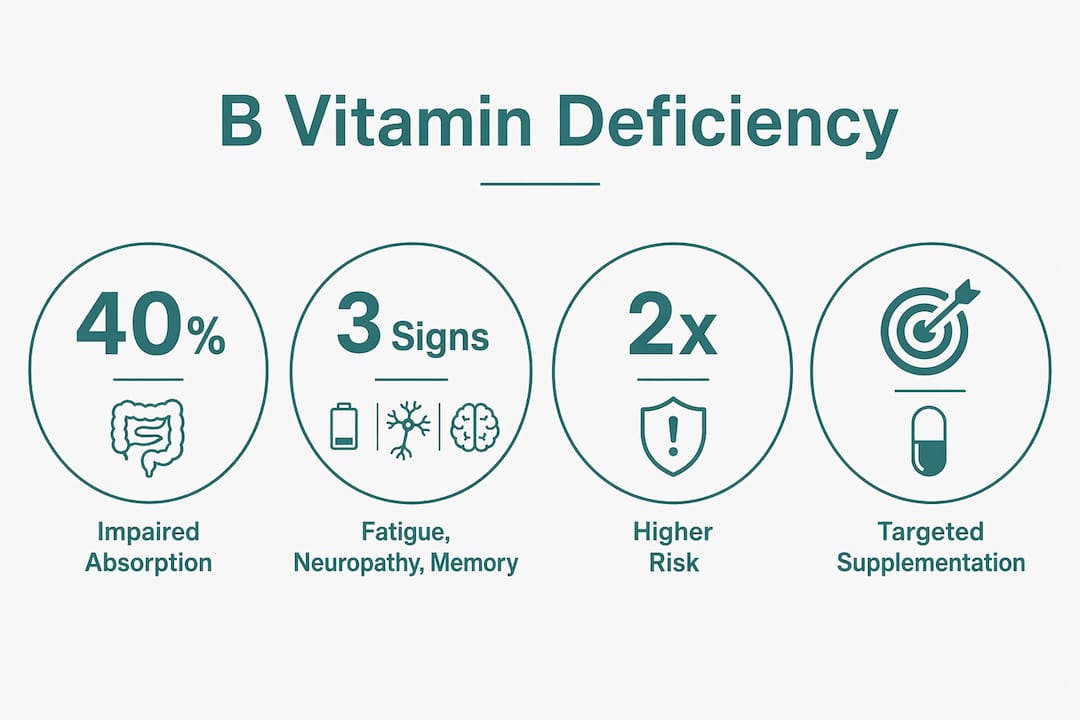
- Reduced stomach acid. Your stomach produces less hydrochloric acid as you age. Stomach acid is needed to release B12 from food proteins. Without it, B12 passes through unabsorbed. About 40% of people by age 75–80 have diminished B12 absorption due to this age-related change.
- Loss of intrinsic factor. Intrinsic factor is a protein produced in the stomach that binds to B12 and carries it into the bloodstream. Conditions such as pernicious anaemia destroy the cells that make it, cutting off B12 absorption almost entirely.
- Medication interactions. Proton pump inhibitors and metformin both reduce B12 absorption and are among the most commonly prescribed drugs in older adults. If you take either of these regularly, your risk of deficiency is meaningfully higher.
- Dietary restrictions. Seniors who follow plant-based diets or who have a reduced appetite consume less B12 naturally, since the vitamin is found almost exclusively in animal products.
- Absorption changes from age 50 onwards. The Linus Pauling Institute identifies B6 and B12 among the top micronutrients for healthy ageing, noting that absorption declines can begin as early as age 50. Diet alone may not be sufficient once these changes take hold.
The combination of these factors means that deficiency is not rare. It is a predictable consequence of normal ageing that requires active monitoring.
What are the signs of b vitamin deficiency in older adults?
B vitamin deficiency symptoms are easy to overlook because they closely resemble what many people assume is simply getting older. That overlap is precisely what makes deficiency dangerous.
Common signs include:
- Persistent fatigue and low energy, even after adequate rest
- Numbness or tingling in the hands and feet (peripheral neuropathy)
- Memory problems, difficulty concentrating, or mental fogginess
- Mood changes, including low mood or increased irritability
- A sore or inflamed tongue, and pale or yellowish skin
B12 deficiency symptoms can mimic normal ageing, which delays diagnosis and increases the risk of neurological damage. Early treatment leads to quicker symptom improvement, but untreated deficiency can cause irreversible harm to the nervous system. That distinction matters enormously. Neurological damage from prolonged B12 deficiency does not always reverse fully, even with treatment.
Because symptoms overlap with normal ageing, seniors with persistent fatigue or neuropathy should seek clinician advice for appropriate testing rather than self-medicating. A blood test is the only reliable way to confirm whether deficiency is the cause.
Should seniors take b vitamin supplements? what the evidence says
The evidence supports targeted supplementation rather than routine use for all seniors. The key distinction is whether a deficiency has been confirmed.
| Situation | Recommended Approach |
|---|---|
| Confirmed B12 deficiency with normal absorption | High-dose oral B12 supplements (often 1,000 mcg daily) |
| Pernicious anaemia or severe malabsorption | B12 injections, as oral absorption is not reliable |
| Taking metformin or proton pump inhibitors long-term | Discuss B12 testing with your GP |
| No symptoms, no risk factors | No routine supplementation needed; focus on diet |
| Plant-based diet with no animal products | Fortified foods or low-dose B12 supplement advisable |
A test-and-treat approach is preferred over universal supplementation in older adults. Supplements are effective when absorption is impaired, but taking them without confirmed deficiency offers little benefit and can mask other conditions. The AARP notes that screening is recommended when symptoms or risk factors are present, with caution advised against routine supplementation.
For seniors who do need supplementation, both oral high-dose B12 and injections are effective. Injections are typically reserved for pernicious anaemia or conditions where the gut cannot absorb B12 at all. In most other cases of deficiency, high-dose oral supplements work well because a small percentage of B12 is absorbed passively, without needing intrinsic factor.
Pro Tip: Before buying any B vitamin supplement, ask your GP for a serum B12 blood test. Knowing your baseline level means you supplement with purpose, not guesswork.
How can seniors maintain adequate b vitamin levels through diet?
Diet remains the first line of defence for maintaining B vitamin status. These are the most reliable food sources and practical steps for older adults.
- Meat, fish, and poultry are the richest sources of B12. Beef liver, salmon, tuna, and chicken all provide substantial amounts per serving.
- Eggs and dairy contribute meaningful B12 and B6, making them useful for seniors who do not eat red meat regularly.
- Fortified foods such as breakfast cereals, plant-based milks, and nutritional yeast provide B12 in a form that does not require stomach acid for absorption. This makes them particularly valuable for seniors with reduced gastric acid.
- Leafy green vegetables, legumes, and wholegrains are good sources of folate and B6, supporting the full B-complex picture.
Beyond food choices, sleep quality matters more than most people realise. The 2025 Frontiers in Nutrition study found that B vitamins combined with good sleep synergistically lower cognitive impairment risk. Addressing both nutrition and sleep together produces better outcomes than either alone.
If you take medications that affect absorption, timing matters. Taking a B12 supplement two hours apart from metformin or a proton pump inhibitor may improve absorption, though you should confirm this with your GP or pharmacist. For a broader view of B vitamins in ageing, Vivetus provides detailed guidance tailored to the over-50s.
Key takeaways
Seniors need B vitamins because age-related absorption changes, common medications, and dietary gaps combine to create genuine deficiency risk that directly harms energy, nerve function, and cognitive health.
| Point | Details |
|---|---|
| B12 absorption declines with age | Around 40% of adults aged 75–80 have impaired B12 absorption due to reduced stomach acid. |
| Fatigue precedes anaemia | B12’s mitochondrial role means tiredness appears before a standard blood count flags a problem. |
| Medications raise deficiency risk | Metformin and proton pump inhibitors both reduce B12 absorption in long-term users. |
| Test before supplementing | A serum B12 blood test should confirm deficiency before starting any supplement programme. |
| Diet and sleep work together | Combining adequate B vitamin intake with good sleep quality lowers cognitive impairment risk significantly. |
B vitamins, ageing, and what the numbers actually tell us
I have read a great deal of research on micronutrients and ageing, and B12 consistently stands out as the one vitamin where the gap between what seniors think they need and what they actually absorb is most consequential.
The statistic that roughly 40% of people aged 75–80 have impaired B12 absorption is not a fringe finding. It comes from multiple independent sources and has been replicated consistently. What strikes me is how rarely this figure reaches the people it affects most. Many seniors assume that eating a balanced diet is sufficient protection. For B12 specifically, that assumption breaks down after a certain age because the problem is not intake. It is absorption.
The other point I find underappreciated is the cognitive angle. The 2025 Frontiers in Nutrition data showing an odds ratio of 0.33 for cognitive impairment in high B vitamin consumers is striking. It does not prove causation, but the signal is strong enough to take seriously, particularly when combined with sleep quality data. These are modifiable factors. You can act on them.
My view is that the most useful thing any senior can do is get a baseline B12 test at age 60, and again at 70. Not because supplementation is always the answer, but because knowing your status removes the guesswork. The importance of B vitamins for older adults is well established. Acting on that knowledge early is what makes the difference.
— Jord
Support your energy and vitality with Vivetus
The research is clear: B vitamins play a central role in maintaining energy, nerve health, and cognitive function as you age. If your diet or absorption capacity leaves gaps, targeted nutritional support can make a real difference.

Vivetus has developed its Energy & Vitality bundle specifically for seniors who want research-backed nutritional support in one convenient product. The bundle combines B vitamins with complementary nutrients chosen to support healthy ageing, with free shipping on orders over €50. If you are looking for evidence-backed supplement choices after 50, Vivetus provides clear guidance alongside its product range to help you make informed decisions.
FAQ
Why do seniors need b12 more than younger adults?
Seniors need more attention to B12 because stomach acid production declines with age, reducing the body’s ability to release B12 from food. Around 40% of adults aged 75–80 have impaired B12 absorption, regardless of how much B12 they consume.
What foods are highest in b12 for older adults?
Beef liver, salmon, tuna, eggs, and dairy products are the richest natural sources of B12. Fortified cereals and plant-based milks are particularly useful for seniors with reduced stomach acid, as the B12 in fortified foods does not require acid for absorption.
Can b vitamin deficiency cause memory problems in seniors?
Yes. B12 deficiency is directly linked to memory problems, mental fogginess, and mood changes in older adults. A 2025 study in Frontiers in Nutrition found that higher B vitamin intake correlates with significantly lower cognitive impairment risk.
Should seniors take a b vitamin supplement every day?
Routine daily supplementation is not recommended unless a deficiency has been confirmed by a blood test. A targeted test-and-treat approach is safer and more effective than taking supplements without a confirmed need.
How quickly do b vitamin deficiency symptoms improve with treatment?
Early treatment typically leads to quicker symptom improvement, but neurological symptoms caused by prolonged deficiency may not fully reverse. Prompt testing and treatment are critical to avoiding permanent nerve damage.